This is the exact email launch strategy I used to help generate $15,905 for a client in 7 days, including the full sending schedule, email types, and the 4 rules every email list launch must follow.
Breakdown of Results:
Before we dive in, here’s exactly where the $15,905 came from:
16 early bird Sales @ $72 each = $1,152
97 Regular Sales @ $147 each = $14,259
2 VIP Upgrades @ $247 each = $494
Total: $15,905 in 7 days
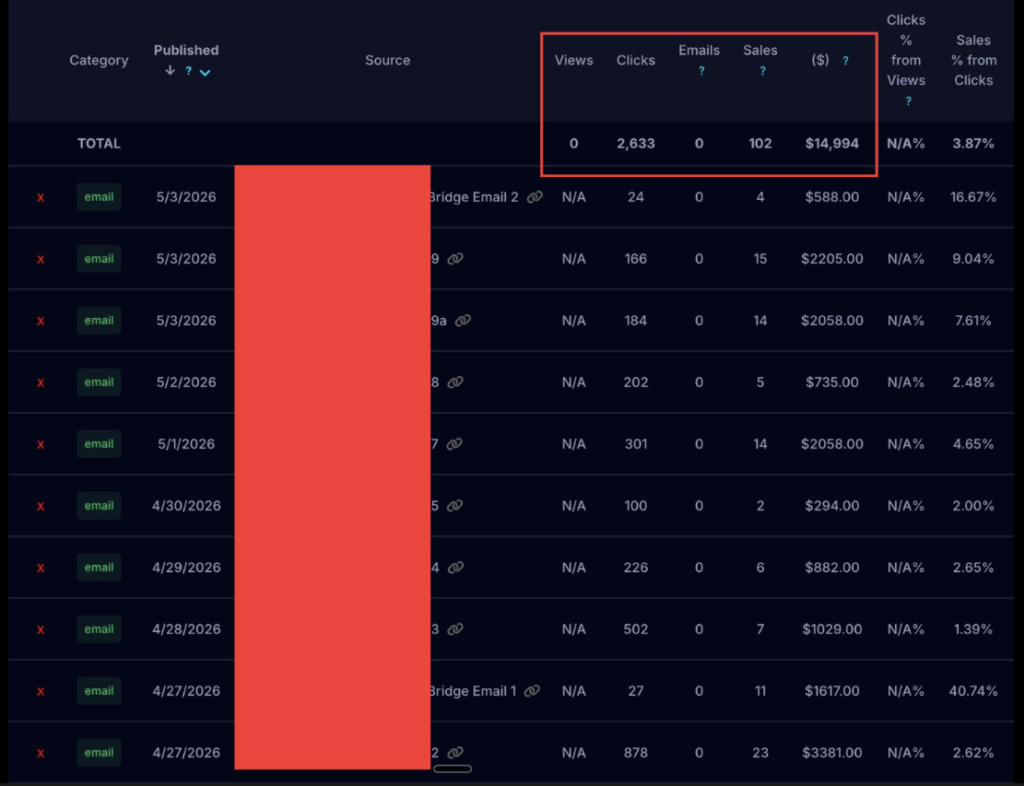
There is a slight discrepancy between the number said in the text and the number in the screenshot.
But the client mentioned how –
“It seems to be missing a few sales, but should be fairly accurate overall”
Since the email would have been the only channel the sales would have come from.
Some Context Before You Go Any Further…
It’s important that you understand the full picture before we get into the strategy, because without this context, it’s easy to read these results and think the emails alone did all the heavy lifting.
Here’s the truth:
This client had been consistently showing up for their audience for a long time.
They were adding fresh, engaged subscribers to their email list on a daily basis, which is one of the most important ingredients in any successful email launch.
And crucially, they had built a compelling offer that their audience actually wanted.
When all of those pieces are already in place, it makes the job of an email marketer significantly easier and the results speak for themselves.
So keep that in mind as you read through this.
The strategy I’m about to share works, but it works best when the foundations are solid.
How Many Emails Did I Send Out During Launch Week?
The launch ran for 7 days, with the doors opening on Monday and closing on Saturday at midnight.
Over those days, I sent a total of 10 emails.
Here’s how the sending schedule looked:
Monday through Friday: One email per day Saturday (final day):
Three emails, one in the morning, one in the early evening, and one as a final last-call.
That final day is where a significant chunk of the revenue was generated.
Every single time I run a launch like this, the last day, particularly those final few hours, produces a surge of sales from people who needed that extra push.
Here is a breakdown of the sales per email:
Email 1: $3381
Email 2: $1617
Email 3: $1029
Email 4: $882
Email 5: $294
Email 6: $2058
Email 7: $735
* Emails 8 to 10 were sent in one day*
Email 8: $2058
Email 9: $2205
Email 10: $588
Some sales were missed, but overall, you can get a sense of where most of the sales came from.
What Kind of Emails Did I Send Out?
Each email had a specific job to do.
The goal throughout the sequence was simple: move the reader one step closer to making a purchase by addressing their hesitations and reinforcing the value of the offer.
Here’s what each email focused on:
Monday – Doors Open:
Clean, direct, and easy to act on.
The sole purpose of this email was to let subscribers know the cart was open and make it as frictionless as possible for them to purchase.
Tuesday – Social Proof:
Nothing builds belief faster than seeing other people succeed.
This email showcased real results from people who had already used the product.
The message was simple: the only difference between those results and the reader’s situation is that those people took action.
Wednesday – Value Stacking:
This email walked through everything included in the offer in detail.
The goal was to make the reader feel like the value far outweighed the price, because it did.
Thursday – Objection Handling:
What’s stopping people from buying?
I identified the most common objections and fears and addressed them head-on.
This is one of the most underrated emails in any launch sequence, and it consistently moves the needle.
Friday – Urgency (Doors Closing Tomorrow):
A reminder that the window was closing.
Just a clear, honest message that time was running out.
Saturday Email 1 (Morning) – Last Day:
Today is the final day.
Simple urgency, clear call to action.
Saturday Email 2 (Evening) – Urgency + Value Reminder:
Same urgency, but with a recap of everything included in the offer.
For anyone still on the fence, this email reminded them exactly what they’d be walking away from.
Saturday Email 3 (Late Evening) – Final Call:
Short and direct.
Two hours left, this is your last chance.
Can I use this sending schedule?
Absolutely, and I’d encourage you to.
But before you copy this framework, make sure you’ve done the work to set yourself up for success.
The sending schedule is only as effective as the foundation it’s built on.
Before running this sequence, focus on these three things:
Refine your offer: Make sure you’re selling something people genuinely want and that the value is crystal clear.
Consistently grow your list: New and engaged subscribers make every campaign perform better.
Mail your list regularly: If you’ve been quiet for months, a sudden sales push will feel jarring.
Stay in front of your audience consistently.
Get those three things right first.
Then layer in this launch sequence, and your chances of success increase dramatically.
4 Rules of an Email List Launch That You Should Follow
These aren’t optional.
In every launch I’ve run that has performed well, these four elements were present.
In every launch that underperformed, at least one of them was missing.
1. Send pre-launch emails and build anticipation.
Don’t let your audience be surprised by a launch.
Tease what’s coming, build excitement, and make them feel like they’ve been on the journey with you from the beginning.
2. Have an offer people actually want to buy.
This is arguably the most important factor in the entire equation.
No amount of clever copywriting will save a weak offer.
As marketing author Mark Joyner puts it, a great offer makes customers feel like they must do business with you, not that they should, but that they must.
3. Use each email to bring the reader one step closer to buying.
Every email in your sequence should serve a purpose: social proof, value stacking, objection handling, or urgency.
Each one should be doing a specific job.
4. Finish strong, send multiple emails on the last day.
On every launch I run, the final day accounts for a disproportionate share of total revenue.
Send at least three emails:
one at the start of the day, one in the early evening, and one as a final two-hour warning.
Don’t hold back on the last day; this is where you can see a real uptick in revenue on your launches.
If you found this breakdown useful and want to explore what a launch like this could look like for your business, feel free to reach out.
The strategy works; when the right pieces are in place, the results follow.